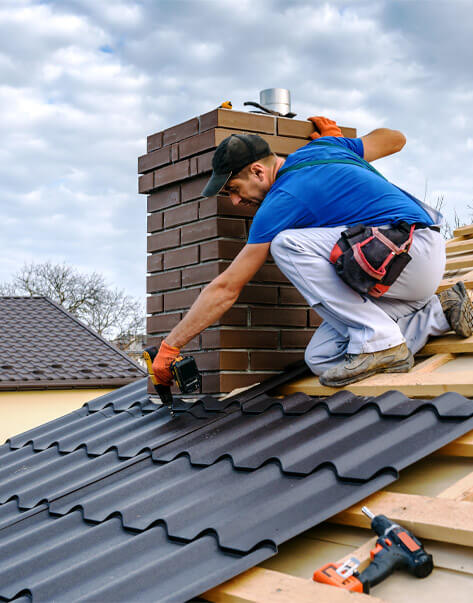
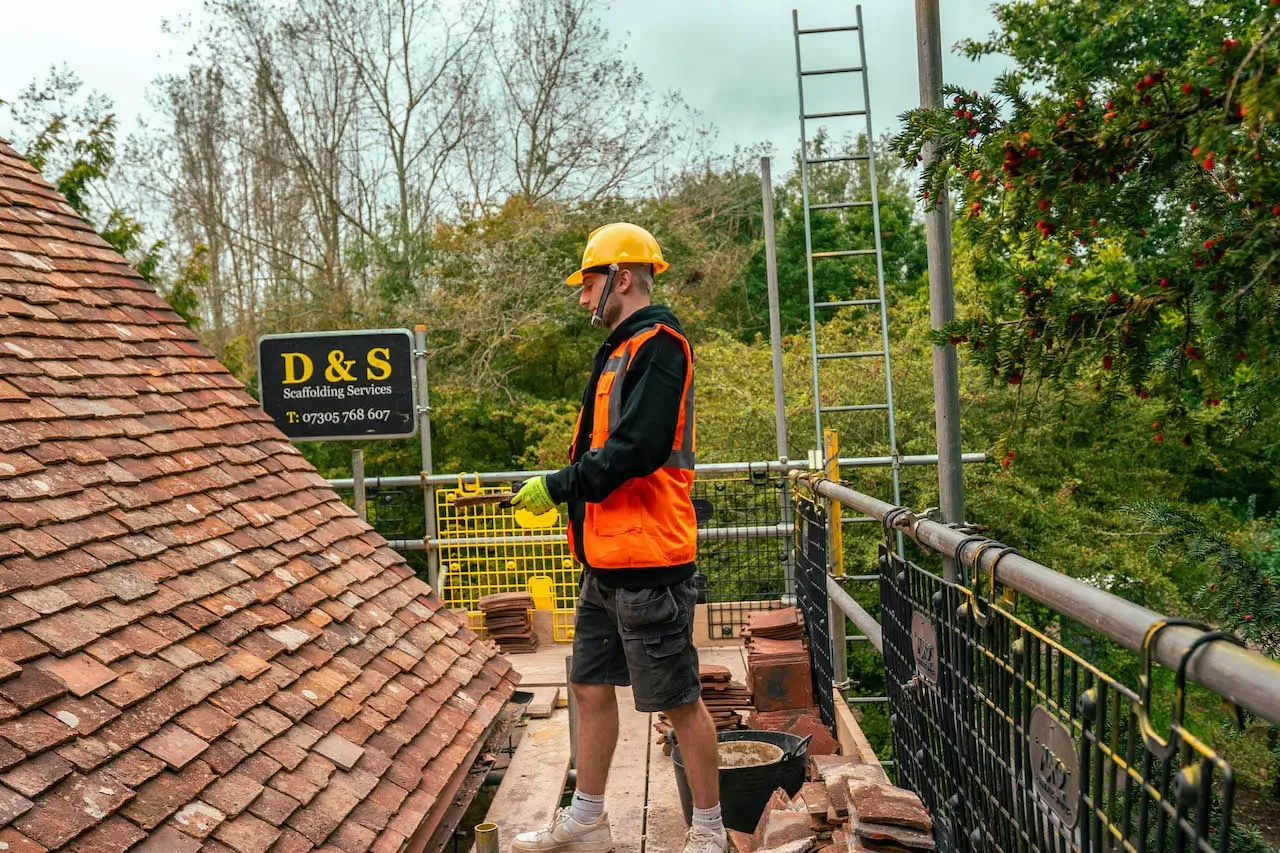
If you are extending your house, adding a garage, or replacing a tired flat roof that has finally given up, you will almost certainly be quoted one of three coverings: EPDM rubber, GRP fibreglass, or torch-on felt. Each has its place. Each has real strengths and real weaknesses. And each is quoted, by different firms, as if it were the only sensible answer. This piece is an honest walk through all three, from a family that has fitted every one of them across north Buckinghamshire since long before EPDM arrived on the UK market.
The short version, if you are in a hurry: for most single-storey extensions on family homes we recommend EPDM. For balconies, walkable roofs and complicated shapes we recommend GRP. For garages, sheds and phased refurbishments where budget is the deciding factor, torch-on felt still earns its place. The long version is below, along with the questions your roofer should be asking you before they ever price the covering.
Three flat-roof systems, one honest comparison
Before the detail, a table you can screenshot and take to a quote meeting. Numbers are typical UK figures for a straightforward domestic roof between roughly 10 and 40 square metres, on a sound warm-deck substrate.
| EPDM rubber | GRP fibreglass | Torch-on felt | |
|---|---|---|---|
| Typical lifespan | 30 to 50 years | 25 to 30 years | 15 to 25 years |
| Installed cost per m² | £90 to £130 overlay £180 to £250 full strip |
£95 to £140 overlay £200 to £270 full strip |
£65 to £95 overlay £140 to £190 full strip |
| Install method | One seamless sheet, bonded | Wet-laid resin and matting, cured on the deck | Three-layer torch-applied bitumen |
| Seams / joints | None on domestic roofs | Chemically bonded, effectively seamless | Overlapped and heat-welded |
| Walk-on finish | Occasional foot traffic only | Yes, hard and walkable | Occasional foot traffic only |
| Weather window for install | Wide, dry conditions | Narrow, needs dry and above 5°C | Wide, but not in rain |
| Manufacturer warranty | 20 years typical | 20 years typical | 10 to 15 years typical |
| Best for | Extensions, dormers, garages | Balconies, terraces, complex shapes | Outbuildings, sheds, budget projects |
Those are averages. The honest truth is that a badly installed EPDM roof will fail in five years, and a properly installed felt roof can outlast a poorly detailed fibreglass one. The covering matters, but the person laying it, and the deck underneath, matter more. We come back to both further down.
EPDM rubber: the low-fuss champion
EPDM stands for ethylene propylene diene monomer, which nobody outside the industry has ever needed to say aloud. What matters is that it is a synthetic rubber sheet, typically 1.2 or 1.5 mm thick, produced in continuous rolls and cut to a single piece for most domestic roofs. It has been used on commercial roofs in the United States since the 1960s and on UK homes seriously since the mid-2000s. It is the system we specify for the majority of the extensions we quote.
Installation
A properly detailed EPDM install goes like this. The deck is prepared and checked for flatness, moisture and adequate falls. A layer of contact adhesive is applied to the deck. The sheet is unrolled, relaxed for a while to reduce shrinkage stress, then rolled back onto the adhesive and bonded down. Edges are dressed into aluminium or hard PVC trims, mechanically fixed. Upstands against walls are dressed at least 150 mm high and terminated behind a wall trim or lead flashing. Drains and outlets are cut in and formed with dedicated corner boots. On a straightforward 20 m² rear extension, a two-person crew fits an EPDM covering in a single working day.
Lifespan
EPDM does not have a headline failure mode. It does not go brittle in UV. It does not crack in frost. It does not soften in summer heat the way bitumen does. Manufacturer test data supports a 50-year expected service life on the sheet itself. In practice, most EPDM roofs we are called back to look at 20 or 25 years on are still watertight on the flat area. Where they leak, it is nearly always at a poorly detailed upstand, a shortcut on a corner, or a movement joint that was not accommodated.
Cost
Somewhere between torch-on felt and GRP, closer to felt. Overlay installs on a sound deck run £90 to £130 per square metre in the Milton Keynes and Buckinghamshire area in 2026. Full-strip and warm-deck rebuilds run £180 to £250 per square metre once insulation, new deck boards, upstands and trims are priced.
When to choose it
Single-storey rear extensions. Garage roofs. Porch canopies. Dormer roof tops. Anywhere the roof is not routinely walked on, is not a decorative visible feature, and needs to last as long as possible for the money. On our own family properties, we fit EPDM.
GRP fibreglass: the seamless option
GRP is glass-reinforced polyester, better known as fibreglass. It is the same family of material used to build boat hulls and car body panels. On a roof, it is laid wet: layers of glass matting are saturated with a two-part polyester resin directly on the deck, then rolled out to remove air, and finally topped with a pigmented topcoat. It cures into a hard, glossy, seamless shell that is bonded to the substrate for life.
Installation
GRP is far more sensitive to conditions than EPDM. The deck must be clean, dry, and sound. Ambient temperature needs to be above 5 degrees Celsius and rising. Humidity matters. It is a chemistry-driven install, not a mechanical one, and the resin cure kicks off the moment the catalyst is added. Corners, upstands and drains are pre-formed with prefabricated GRP trims which are then over-laminated. On a 20 m² roof, expect two or three days on site including the topcoat.
Lifespan
Well laid, 25 to 30 years is realistic. The topcoat is UV-sensitive and will chalk and fade over time, but the underlying laminate holds. GRP fails when the resin was under-catalysed on install day (soft patches that never fully cure), when it was laid on a moving deck (hairline cracks along joist lines), or when the topcoat was applied too thin (early crazing). None of those are inherent flaws, all of them are workmanship issues.
Cost
The most expensive of the three on a like-for-like basis. Overlay installs, where feasible, run £95 to £140 per square metre. Full-strip warm-deck rebuilds run £200 to £270 per square metre. GRP also has the highest labour content, so tight-access projects push the price further.
When to choose it
Balconies and terraces where the roof is a walking surface. Complex geometry that is hard to sheet in one piece: multiple drains, curved upstands, roof lanterns dropped into flat areas. Roofs where the finish is visible from above and colour or texture matters. Coastal or heavily UV-exposed projects where the walk-on hardness is genuinely useful. It is a fine system in the right context, just not a default one.
Torch-on felt: still the value pick
Torch-on felt, sometimes called SBS modified bitumen, has an image problem. Most homeowners picture the split, blistered, bubbled black felt of a 1970s garage. That is not what we are talking about. Modern three-layer torch-on felt is a genuinely capable system: a torched vapour barrier, a mid-layer, and a mineral-finish cap sheet, each welded to the next with a controlled gas torch.
Installation
The deck is checked and prepared. A vapour barrier is torched down. Insulation is bonded on for warm-deck construction. The underlay felt is unrolled and torched to the insulation. The cap sheet, with its mineral finish, is unrolled on top and heat-welded on its overlaps. Details are formed with cut-and-torched pieces at upstands, corners and drains. On a 20 m² garage roof, one to two days on site depending on the number of details.
Lifespan
15 to 25 years is realistic for a properly installed three-layer system. The failure modes are known: UV degradation of the mineral finish, movement cracking at the perimeters, blistering where trapped moisture below turns to vapour in summer heat. All of them are slow enough to spot in an annual visual check.
Cost
The most affordable of the three. Overlay installs on a sound deck run £65 to £95 per square metre. Full-strip warm-deck rebuilds run £140 to £190 per square metre. On small outbuildings the price difference against EPDM narrows to almost nothing, because the fixed minimum-visit cost dominates.
When to choose it
Detached garages. Sheds. Workshops. Outbuildings that would be difficult to insure at a higher spec. Phased refurbishments where the flat roof needs 15 years of service now, before the whole property is redeveloped. Rental properties where the landlord needs a lower up-front cost with a reasonable service life. There is nothing dishonest about specifying felt in these contexts.
Liquid systems: when a fourth option makes sense
Occasionally a liquid-applied waterproofing system is the right answer. Products such as Kemper, Sika Liquid Plastics or Cromapol are painted or rolled on wet and cure to a seamless membrane. They come into their own on roofs where geometry is impossible: multiple pipe penetrations, an old mineral felt roof that cannot be lifted for structural reasons, or a listed property where visual continuity matters. Costs vary widely, from £70 per square metre for a maintenance overcoat to £180 per square metre for a full new build-up. We do not lead with liquid systems, but we will specify them when a survey shows the roof will fight anything else.
Warm deck vs cold deck: the insulation question your roofer should ask
Before your roofer talks about the covering, they should be asking where the insulation goes. This is the single most important detail on a modern flat roof and the one most often botched.
A warm deck flat roof places rigid insulation on top of the structural deck, directly under the waterproof covering. The deck stays at internal room temperature. There is no cross-flow ventilation needed. Condensation risk drops to almost zero. This is the current default recommendation for any new or fully replaced flat roof on a habitable extension. It is also what Building Regulations Part L, in most cases, will push you towards.
A cold deck flat roof puts insulation between the joists, below the deck. The deck sits cold, and needs cross-ventilation to prevent condensation. It is cheaper, thinner in total build-up, and appropriate in some retrofits where headroom is a real issue. But it is unforgiving, and if the ventilation path is ever blocked, the deck rots quietly. We only specify cold deck when there is a genuine constraint that rules out warm deck.
If a quote you have received does not mention which construction they are proposing, ask. It is more important than the choice of covering.
Falls, drainage and ponding: why the deck matters more than the covering
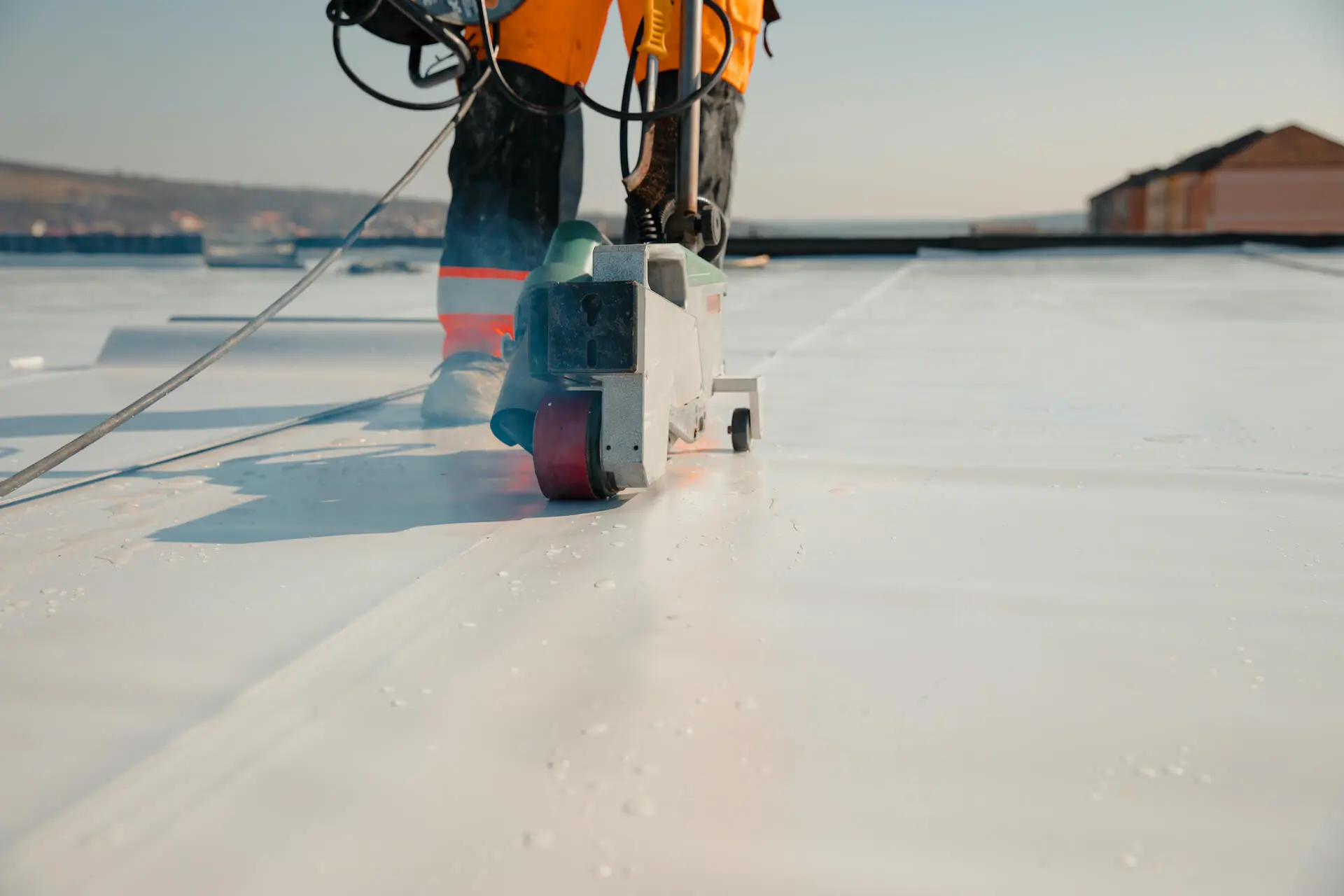
A flat roof is never actually flat. It needs a designed fall of at least 1 in 80 to drain, and in practice we build to 1 in 60 to leave margin. Ponding, the pooling of water on the roof for more than 48 hours after rain, is the single largest cause of premature failure on all three systems. It is not the covering that fails, it is the constant wet-dry cycling of edge details, the ultraviolet burn on the standing water, and the extra weight loading the deck.
If your existing roof ponds, the answer is not to just re-cover it with something better. The answer is to correct the falls first. That usually means tapered insulation boards on a warm-deck build-up, or firring pieces on the joists in older constructions. Either adds a few hundred pounds to the job. All three coverings work well on a properly drained deck. None of them cope well with standing water year after year.
Cost per m² honest breakdown
Rounded 2026 figures for the Milton Keynes and Buckinghamshire area, based on our recent quotes. These assume a domestic roof between 10 and 40 square metres with reasonable access.
- Overlay on sound deck, EPDM: £90 to £130 per square metre.
- Overlay on sound deck, GRP: £95 to £140 per square metre.
- Overlay on sound deck, torch-on felt: £65 to £95 per square metre.
- Full strip and warm-deck rebuild, EPDM: £180 to £250 per square metre.
- Full strip and warm-deck rebuild, GRP: £200 to £270 per square metre.
- Full strip and warm-deck rebuild, torch-on felt: £140 to £190 per square metre.
- Additional for tapered insulation to correct falls: £25 to £45 per square metre.
- Additional for new fascia, gutter and downpipe: £45 to £75 per linear metre.
Smaller roofs, roofs with tight access, and roofs with multiple penetrations sit above these ranges. Larger commercial roofs sit below them.
Which system for which extension
The right answer depends more on the geometry and use than on the material. A quick guide.
Single-storey rear extension, 15 to 30 m². EPDM in one sheet, warm deck, aluminium edge trims. This is the standard configuration on most of our residential work and typically the best long-term value.
Detached garage, 12 to 20 m². Torch-on felt if budget is tight and the garage is not being brought into the main insulated envelope. EPDM if you want it to be the last time you touch that roof.
Dormer cheek and top, 4 to 8 m². EPDM. The sheet takes complex movement well and the seamless join between vertical cheek and horizontal top is genuinely watertight when detailed correctly.
Porch canopy, 2 to 6 m². EPDM again on modern porches. GRP on period property where a moulded trim needs to blend into a decorative fascia.
Balcony or roof terrace, any size. GRP, or a hybrid GRP tanking under a floated deck. Walk-on hardness is the deciding factor here and neither EPDM nor felt is designed for it.
Complex commercial or mixed-use flat roof. EPDM for large clean rectangles. Torch-on felt for phased refurbishments and shed roofs. Liquid systems where penetrations dominate.
How long a properly installed EPDM roof lasts, real numbers
We are asked this most weeks. Here is what forty years of walking flat roofs tells us. The material itself, the EPDM sheet, has a documented service life above 50 years and shows no sign of intrinsic failure on any of the domestic roofs we installed in the 2000s that we still visit for other reasons.
Where an EPDM roof does eventually need attention, it is nearly always at the perimeter details. The aluminium trims, the upstand terminations, and the drain outlets are the hard-working parts. Those may need a service visit at 20 years, a re-dress at 30 years, and possibly a full perimeter refresh at 40. The sheet itself carries on. If you are buying an EPDM roof today and want a genuinely realistic expectation, plan for 40 years of low-maintenance service with a light perimeter service at the 20-year mark. That compares favourably against any other flat-roof system on the UK market at this price point.
The covering is the easy part. The deck, the falls and the perimeters are what actually decide whether your flat roof lasts fifteen years or forty. a note we make on almost every survey report
What happens next
If you are pricing an extension roof, replacing a tired garage top, or comparing quotes for a flat-roof re-cover, the most useful next step is a proper survey. We will assess the existing deck, check the falls, take moisture readings if there is a suspicion of trapped water, and give you a written comparison of the two or three coverings that would genuinely suit your property. If EPDM is the right answer we will say so. If felt is the right answer we will say that too. See our flat roofing service for scope and specifications, or request a free survey to get started. You can also call 07497 711223 directly and speak to a member of the family.
Free flat-roof survey and honest specification advice, one phone call away.
Common questions.
The questions we hear most often when homeowners ring us about a flat roof.